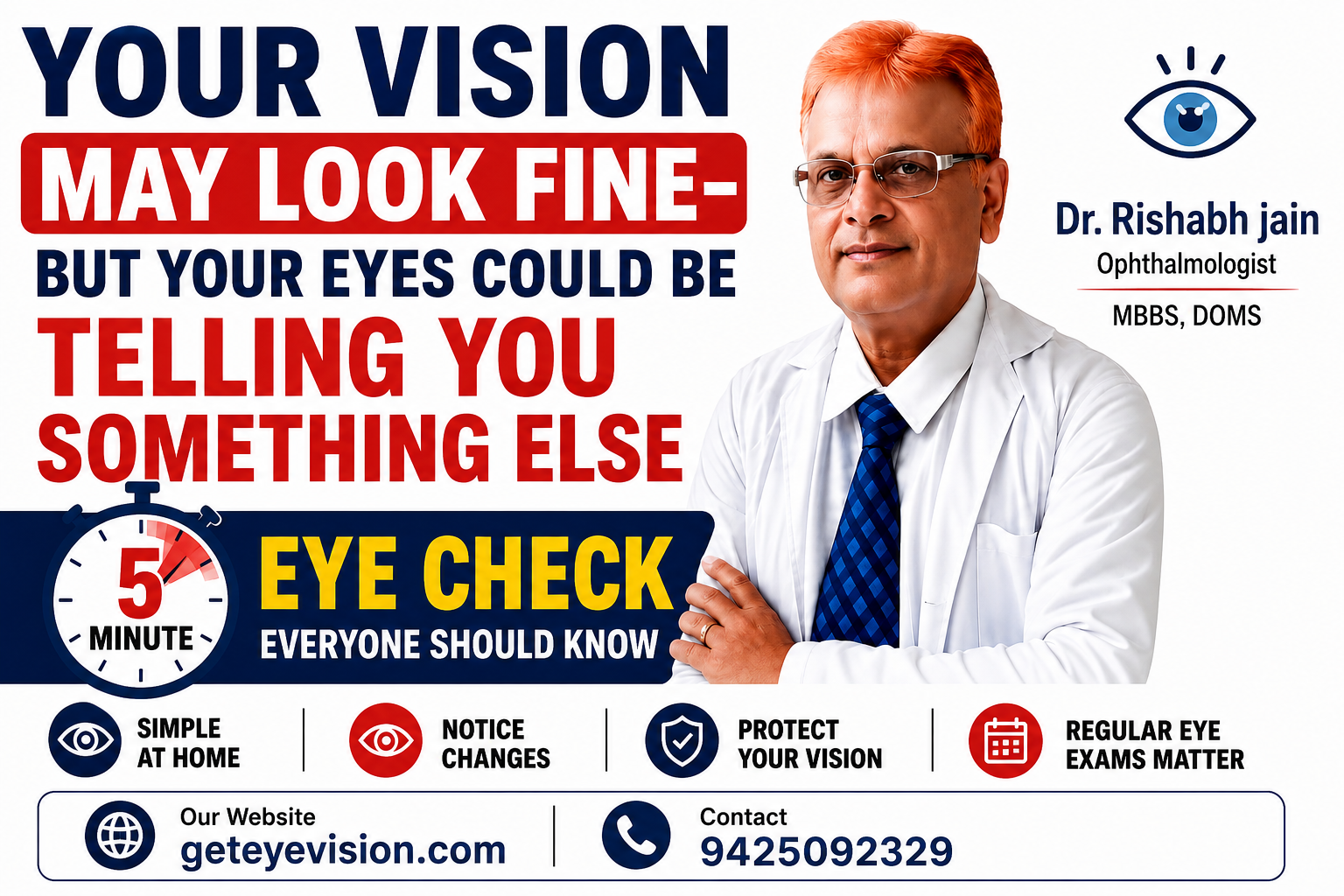
You can read this sentence. You can use your phone. You can recognize faces, watch videos, and move through your daily life without difficulty. So, naturally, you may assume that your eyes are completely healthy. But clear vision does not always mean healthy eyes.
Many eye conditions can develop silently without pain, redness, or noticeable changes in vision during their early stages. Sometimes, by the time symptoms become obvious, valuable vision may already have been affected. This is why eye health requires more attention than simply asking, “Can I see clearly?”
The good news is that you can spend just a few minutes becoming more aware of how your eyes are working. A simple five-minute vision awareness check at home can help you notice changes that may need professional attention. However, it is important to understand that this is not a medical test. It cannot diagnose eye disease, confirm that your eyes are healthy, or replace a comprehensive eye examination.
Think of it as a way to understand your normal vision and recognize when something feels different. This awareness can be especially important for people with diabetes, a family history of glaucoma, increasing age, previous eye problems, or any unexplained changes in eyesight.
Your eyes work every moment of your life—helping you read, work, drive, recognize people, and experience the world around you. Taking a few minutes to pay attention to them today can make a meaningful difference in protecting your vision for the future.
The Biggest Eye Health Mistake: “I Can See Clearly, So My Eyes Are Healthy”
One of the most common misunderstandings about eye health is believing that clear vision automatically means healthy eyes. While good eyesight is certainly important, it does not reveal everything happening inside your eyes.
Some eye diseases can progress quietly without creating obvious symptoms. Glaucoma is one of the best examples. It can slowly damage the optic nerve, often without causing noticeable problems in the beginning. Because the changes happen gradually, many people continue their normal activities without realizing that their vision is being affected.
Another example is diabetic retinopathy. People with diabetes may develop changes in the retina before they experience significant vision problems. This is why regular eye examinations are essential, especially for individuals with risk factors.
The purpose of a home vision awareness check is simple: it helps you notice changes. It does not prove that your eyes are disease-free.
Minute 1: Compare Each Eye Separately
One of the easiest things you can do is compare the vision between your two eyes.
Choose an object across the room that has recognizable details. It could be a clock, television text, a calendar, a picture frame, or any object with fine details. If you normally wear glasses or contact lenses for distance vision, use them during this check.
Cover one eye gently without pressing on it. Look at the object using only the uncovered eye. Then switch sides and repeat the same process with the other eye.
Now ask yourself:
Does one eye appear blurrier than the other?
Does one eye seem darker or less clear?
Are details harder to recognize with one eye?
Do you notice any missing or unusual areas in your vision?
A difference between your eyes does not always mean something is wrong. Many people naturally have different prescriptions in each eye. However, a new difference or a noticeable worsening compared with your previous vision should not be ignored.
Because both eyes usually work together, one stronger eye can sometimes compensate for a weaker eye. This means changes in one eye may go unnoticed unless you deliberately compare them.
If you notice a significant new difference, an eye examination can help identify the reason.
Minute 2: Check Your Reading Vision
Now choose something you read regularly—a book, newspaper, medicine label, or your phone screen. Read it at your normal distance without forcing your eyes.
Pay attention to how the words appear.
Ask yourself:
Are letters becoming harder to focus on?
Do words appear blurry or unclear?
Do you need much brighter light than before?
Are parts of words missing?
Do letters appear distorted?
Some difficulty with close-up vision is a normal part of aging. A condition called presbyopia occurs because the eye gradually becomes less flexible and has more difficulty focusing on nearby objects. Many people eventually need reading glasses because of this natural change.
However, not every new vision problem should automatically be blamed on age.
If words suddenly appear distorted, if parts of your vision seem missing, or if you notice an unusual change in your central vision, it is important to seek professional advice.
Minute 3: Look at Straight Lines
The next simple awareness check involves looking at straight lines.
Find something with clear lines, such as a window frame, door edge, tiled floor, notebook page, or a grid pattern. Look at it carefully with one eye at a time.
Ask yourself:
Do the lines look straight?
Or do they appear:
Wavy?
Bent?
Broken?
Distorted?
Interrupted?
This is not a diagnostic test, and lighting conditions or the object itself can affect what you see. However, new distortion in your central vision should not be ignored.
The macula is the central part of the retina responsible for detailed vision, including reading, recognizing faces, and seeing fine details. Problems affecting this area can sometimes cause changes such as distorted lines or difficulty seeing clearly in the center of your vision.
If straight lines suddenly appear curved or objects look unusually distorted in one eye, schedule an eye examination.
Minute 4: Do Not Try to Diagnose Glaucoma at Home
Many people search online for quick glaucoma tests. One common suggestion is checking peripheral vision by having someone move an object from the side while you look straight ahead.
Although this may seem helpful, it cannot reliably detect glaucoma.
Glaucoma develops differently in each person and can progress silently. By the time someone notices significant loss of side vision, the optic nerve may already have experienced serious damage.
A proper glaucoma evaluation may include several professional tests, such as measuring eye pressure, examining the optic nerve, and performing visual field testing when needed.
Instead of trying to diagnose glaucoma yourself, ask a more important question:
“When was my last complete eye examination?”
If you cannot remember, it may be time to schedule one.
Minute 5: Ask Yourself These Important Eye Health Questions
After completing the awareness check, take a moment to think about your overall eye health.
Has your vision changed recently?
Changes do not always mean complete loss of vision. They can include difficulty reading, worsening night vision, increased blurriness, or one eye feeling different from the other.
Does one eye see differently from the other?
A difference that has existed for years may simply be related to your eye prescription. However, a new change should always be evaluated.
Are you seeing new flashes or floaters?
Floaters are small spots, lines, or shapes that move across your vision. Many are harmless, but a sudden increase in floaters, especially with flashes of light, can sometimes indicate a retinal problem.
A dark curtain, shadow, or veil appearing across part of your vision requires urgent medical attention.
Do you have diabetes?
People with diabetes have a higher risk of developing diabetic eye disease. Important changes can occur in the retina before symptoms appear, which is why regular eye examinations are essential.
When was your last eye examination?
A comprehensive eye examination is not only about checking whether you need glasses. It allows an eye-care professional to examine important structures inside your eyes and identify problems that may not be visible to you.
Why Regular Eye Examinations Matter
An eye examination provides much more information than a simple vision chart test.
During a professional examination, an eye specialist may evaluate your visual clarity, eye pressure, pupils, optic nerve, retina, and other important structures depending on your needs.
Conditions such as glaucoma can permanently affect vision if left untreated. While lost vision cannot always be restored, early detection and proper management can help protect the vision you still have.
That is why “I can see well” and “My eyes are healthy” are not always the same thing.
Warning Signs You Should Never Ignore
Most changes in vision are not emergencies, but some symptoms require immediate attention.
Seek urgent medical care if you experience:
Sudden vision loss.
A sudden increase in floaters.
New flashes of light.
A dark curtain or shadow in your vision.
Sudden severe distortion.
Severe eye pain with blurred vision.
A painful red eye with vision changes.
Your eyes deserve quick attention when sudden changes occur. Waiting to see if symptoms disappear can sometimes put your vision at risk.
Who Should Take Eye Health More Seriously?
Everyone should care for their eyes, but some people may require more frequent monitoring.
You should discuss your eye examination schedule with an eye-care professional if you have diabetes, a family history of glaucoma, increasing age, previous eye disease, eye injury, eye surgery, or unexplained changes in vision.
There is no single examination schedule that works for everyone. Your eye-care professional can recommend the right timing based on your individual health and risk factors.
The Real Purpose of the Five-Minute Eye Check
Spending five minutes checking your vision is a simple way to become more aware of your eyes. Cover one eye, then the other. Read something familiar. Look at straight lines. Notice whether anything feels different.
But remember: a normal home check does not guarantee healthy eyes.
This five-minute check is a reminder, not a diagnosis.
It helps you recognize changes. A professional eye examination helps explain those changes.
Your eyes allow you to experience life—from reading and working to seeing the faces of people you care about. Protecting your vision starts with awareness, regular care, and taking changes seriously.
Do not wait until your vision becomes obviously poor before paying attention to your eyes.
Five minutes can help you notice a change. A professional eye examination can help protect your vision.
Medical Disclaimer: This article is for educational purposes only and does not replace professional medical advice, diagnosis, or treatment. Home vision checks cannot diagnose or rule out eye disease. If you experience sudden or severe changes in vision, seek urgent medical attention.